
Stitched Masterpieces

Exploring the World’s Largest Quilt Collection
by Patty Beutler • photos by Tom Tidball
If a museum dedicated to quilts makes you wonder why anyone would display sleepy-time bed coverings favored by your great-grandmother, think again. And prepare to be surprised.
Lincoln’s International Quilt Museum (IQM), at the corner of 33rd and Holdrege streets adjacent to East Campus of the University of Nebraska-Lincoln, will change your mind in an instant. The holdings within capture the creative minds and skillful hands of quilters who use fabric, needle and more to fashion canvases of radiant color and inventive design, a far cry from the traditional needlework of days gone by. But there is plenty of that too.
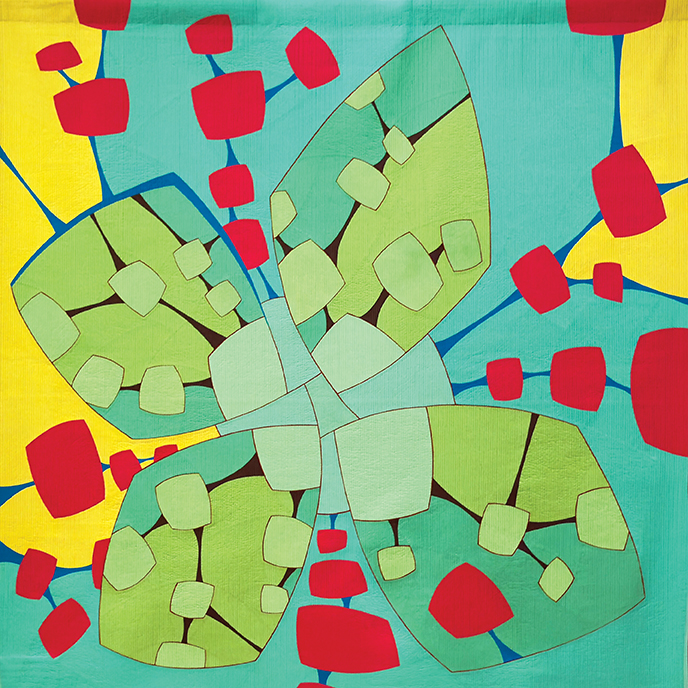
photo by Tom Tidball of Keetje Abbenhuis’s “Big Bang or Life under the Microscope”
Hanging on the walls are exhibits of various size and shape, handsomely curated by theme or artist or colors or country that mesmerize the viewer who ponders: how did they ever do that?
A visit to the museum is a walk through the creative genius of so many different artists from across the country and around the world. Like trekking through the halls of any gallery, you are drawn to the pieces for a closer examination. Some of the stitch work, by machine or hand, is so miniscule that one wonders how the creator ever managed that.
Instead of imagining the hangings as traditional bed covers, you appreciate the pieces as works of art and the quilter as the artist. The experience is the same as viewing paintings at the most prestigious museums.
Quilters embellish their pieces with a variety of materials, from microfiche and photographs, to metal threads, mirrors, shells, glass and other items. One quilt, made during the COVID years, even uses rolls of toilet paper, which aren’t apparent until one steps near for a closer look.
The collection of some 11,000 items includes 9,500 quilts, a few from the 1700s up to many from contemporary times. They represent items from 67 countries, some signed by the artist and many without the names of the maker. The expansive holdings also comprise clothing, jewelry, trinkets and household items crafted of fabric and needlework.
“The depth and breadth of our collection is encyclopedic,” says Leslie Levy, in her 11th year as director of the museum.
She is aware of the museum’s splendid worldwide reputation.
“What makes the International Quilt Museum so unique is that we have the world’s largest publicly held collection,” she explains. Other quilt or textile museums in the United States tend to be niche, she says, collecting only a certain type of quilt. Others borrow quilts from various museums to exhibit or show only the works of regional quilters.
“We have an international collection that spans over 500 years and 67 countries, so nowhere else in the world is there a collection as diverse and unique as ours.”
No fear that repeated visits will reveal the same hangings on the wall. Exhibitions change every three to four months in the building’s five formal galleries and two smaller public spaces.
While the galleries are rarely crowded, the museum hosts visitors from every state each year and an average of those from 50 to 60 countries. More than 150 visitors enter the center for free during the First Friday art walks monthly from 4 to 7 p.m.
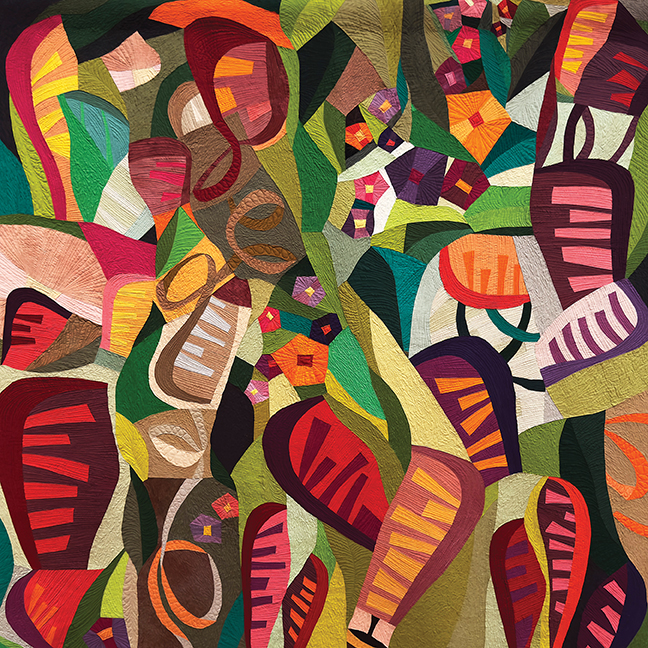
photo by Tom Tidball of Jean Howard’s “She Loves Me”
Levy revels in the comments she hears when she walks through the galleries. “It’s so much fun because we’re never sure who we’re going to meet,” she says. “We have those snowbirds who are traveling across the United States, and they always make the museum one of the stops along the way.”
Among the messages recently left on the visitor comment board: “Didn’t know what to expect coming here… but I was blown away. So impressed with the pieces and their messages. Feeling enlightened!”
The museum books exhibitions several years out, conscious of varying the fare. “We try to have a nice mix that shows something antique or historical, something contemporary or modern or something international,” Levy says.
Sometimes the variety includes borrowed quilts, as those of documentary producer Ken Burns, or follows a color theme, such as a red-and-white show, or features the work of a particular quilter or a curated show of the museum’s holdings.
Often before a show opening, the museum features a free public talk by one or more of the quilt makers whose works are newly on display.
And because the IQM is an academic museum, many researchers spend time studying the contents.
Supporting the museum’s work are 13 full-time staff, two part-timers and 122 volunteers who do everything from helping with conservation and hanging exhibitions to serving as docents on free tours at 11 a.m. Tuesday through Friday.
‘We’re small but mighty,” says Levy, “and that means our volunteers are really critical to our success.”
The museum got its start in 1997 with the donation of nearly 1,000 quilts from Robert and Ardis James. It grew to a freestanding building in 2008 and to its current size with an expansion in 2015 that doubled the exhibition and gallery space.
The curved building of glass and metal is both intriguing and inviting. The newest addition is a colorful installation inside and out by Rachel Hayes called “The Space Between,” made possible by some donors. The interior “sails” over the stairs are made from organza and Roscolux lighting filters with monofilament thread and Stamoid binding, while the exterior piece is made weather-proof with Polyfab Shadecloth, polyester webbing on a steel triangle and sewn with Gore Tenara thread. Both mirror the vibrant colors and designs of the collection.
And the gift shop is worth a mention. Not only will you find an assortment of quilting supplies, you’ll be mesmerized by the display of scarves, jewelry and leather goods that are hard to resist.
The museum’s splendid reputation goes well beyond Lincoln and Nebraska. On a recent trip to Iceland, a friend mentioned that he was from Lincoln. The immediate response from his new acquaintance: “I must go there. I want to visit the International Quilt Museum!”



You credit the dude photographer but not the (presumably women) makers of the quilts? This is so typical….
Hi Rebecca, thanks for your comment. I have gone through the virtual exhibit at the IQM website and updated the credit for the photos to include some more information about the works. These pieces were curated by Nancy Crow for a touring show, and the specifics were not listed on the exhibition page. There is a bit more information available at the IQM’s website if you go to the virtual exhibition, though! (www.internationalquiltmuseum.org/exhibition/color-improvisations-3).