
Parks & Recreation
by Mary Kay Roth
Play for All.
That’s what Lincoln’s leaders want for the community’s children.
Focusing on the goal of ensuring every single child has a place to play, inclusive playgrounds have become some of the shining stars that sparkle on the canvas of Lincoln Parks and Recreation.
Indeed, the city unveiled a milestone inclusive park this summer at Mahoney Park in north Lincoln, and will unveil another in 2026 at the new South Haymarket Park (now under construction in the green space south of the Haymarket).
These playgrounds embody Lincoln’s commitment to provide every child with opportunities to explore, connect, and thrive, according to Mayor Leirion Gaylor Baird.
She says of the Mahoney unveiling: “This playground reflects Lincoln’s values. It’s a space designed with intention, care, and heart. A space where children of all abilities can laugh, learn, and play together. And it’s a symbol of what we can accomplish when we unite around a shared vision of inclusion and access for all.”
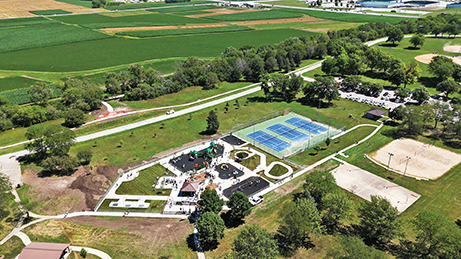
The nearly 34,000 square-foot fenced area is five times larger than the previous playground and includes a pathway loop to access different play zones, open green space, and sensory gardens. The design consists of a centralized shade shelter, drinking fountain, interactive water table, and new play equipment that provide accessible and inclusive play experiences such as swinging, sliding, rocking, climbing, balancing, imaginative play, and fitness.
“Lincoln, Nebraska, is serious about making sure every child can play in our playgrounds — they should be for everyone,” says Kat Scholl, public information specialist for Lincoln Parks and Recreation. “That’s why we are focused on providing all-inclusive spaces in playgrounds across Lincoln.”
Scholl explains that the all-inclusive playground design includes physical accommodations that provide access and specialized equipment to meet specific needs, as well as providing opportunities for everyone to explore and play with children and adults who may have different levels of ability.
“As new parks are developed and older parks are renovated,” Scholl says, “we are focused on providing at least one single all-inclusive piece of equipment. We are planning this in all our parks.
Located near 70th and Fremont streets, Mahoney’s newest renovations are the result of listening to the needs of residents and forging innovative community partnerships that meet those needs, says Parks and Recreation Director Maggie Stuckey-Ross.
She says parks help define neighborhoods and make them places where people want to live.
Calling Mahoney Park a cornerstone of northeast Lincoln, she says:
“This playground is a reflection of what happens when a community dreams big — and a city listens. It’s what happens when a community rallies together for each other.”
City Council member James Michael Bowers agrees: “Kids with disabilities deserve the same opportunities to play and learn alongside their peers in environments designed with accessibility and inclusivity in mind. Our community’s investment in this inclusive playground, and in future ones, not only breaks down physical barriers, it builds up a sense of belonging and community for all children.”
Scholl says other parks have added a variety of inclusive play features. Still, Mahoney serves as Lincoln’s first all-inclusive, fully fenced-in playground area — and she puts emphasis on fenced-in.
During the time they were designing the playground — the Play-for-All campaign — the city pulled together a wide variety of people with representation from all parts of the adaptive community and asked for their insight and perspective, their priorities for the new space.
“We wanted to make sure everyone of any ability would be able to enjoy it,” Scholl explains.
But beyond appropriate play equipment and wider ramps, there was consensus on one primary request: ensuring a fully enclosed area with only one entrance and exit.
“We were building something five times the size of previous inclusive playgrounds, so parents wanted to make sure they could enjoy the space without worrying — they lobbied for a single pathway for everyone to get in and get out.”
At Mahoney, for instance, there are large bench swings where you can relax, and still be able to watch and observe your loved ones enjoy the space, without worrying about safety.
And there’s more, Scholl continues.
Mahoney Park renovations also include a new exercise area with instructions on each structure – tennis and pickleball courts — a new water table feature — a music zone — and a communications board that demonstrates English, Spanish, and sign language, as well as how to communicate nonverbally.
“Everything is more spread out and so much fun. We’re very proud of this spectacular space.”
Meanwhile, the new South Haymarket Park — southwest of 7th and N streets near the Canopy Park Apartments — also promises a pretty spectacular inclusive space, Scholl continues.
Scheduled to open in 2026, the park will span over 8.5 acres of a currently vacant triangle of land. Overall highlighted features include: a huge, newly designed razzle-dazzle in-ground skate park for skateboarders, BMX riders, two-wheel scooters, and roller skaters — a fenced-in dog park — interactive water features, spray ground and plaza — a year-round hearth — porch swings – huge overhanging canopies — native plantings – and a rentable community building.
And, of course, the new space will also showcase an inclusive playground with unique zones for all ages and abilities.
City leaders explain that the downtown area has needed a green space for some time — beyond patches here and there — which means the South Haymarket Park will stand as something of a love letter to Nebraska.
“We see the South Haymarket Park as an open urban space with a Hub and Soul kind of vibe,” Scholl says. “It will be a common ground for gathering, a pretty notable space, one that will have lots of fun.”
Lincoln Parks and Recreation: Lincoln Parks and Recreation encompasses 168 parks, 185.9 miles of trails, 97 playgrounds, more than 83,000 street trees, nine public pools, six recreation centers, five golf courses, five dog runs, a nature center, and beautiful public gardens.
Parks and Recreation programs include recreation summer day camps, before and after school care, clubs and classes for individuals with special needs, adult and youth team sports, nature-based classes and events, swimming lessons, wellness and fitness classes for all ages, and a variety of free events and classes for all ages.



Recent Comments