
Music Box
By Julie Nichols
Lincoln’s development has surged in recent years, and it shows. The revival of the Haymarket — the building of Pinnacle Bank Arena, subsequent focus on retail, housing and entertainment — has been a locus of Lincoln’s growth. Now, with the advent of a dedicated music district, the city turns downtown to recognize its own cultural history and the clubs that fostered Lincoln’s rich and steadfast music scene.
The foundation of Lincoln’s thriving music scene was laid over 50 years ago when Zoo Bar owner Larry Boehmer, then an art student, booked Luther Allison, its first national act. Over the next five decades, more would follow: Buddy Guy, Jay McShann, Bo Diddley, Albert Collins, Koko Taylor, Son Seals. Larry opened the door to nothing less than a cultural phenomenon.
The oldest blues bar in a continuous location in the country, the Zoo hasn’t wavered in presenting quality shows in an intimate friendly atmosphere. There are two shows almost every night — not just blues, but rockabilly, reggae, jazz, surfpunk, funk and even a live karaoke band every Thursday.
Boehmer Street acknowledges the Zoo Bar’s seminal influence in developing a scene that has only become more vibrant over time. July’s Zoofest paved the way for Lincoln Exposed, a three-day event featuring over 100 local bands, and Lincoln Calling, a festival that pairs touring bands with local acts. Many outdoor series have become regular summer fare: at the Mill Telegraph, Union Plaza below Hub Café, Stransky Park (KZUM), and Jazz in June.
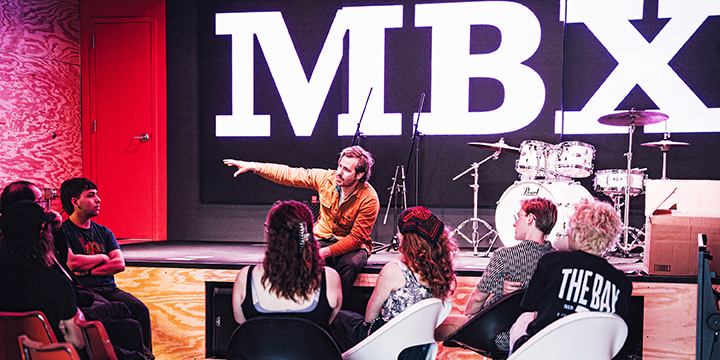
Philip Zach speaks to a group of Music Pathway students from the Bay Gap Year program; photo by Madi Waltman
Around the corner from the Zoo, Duffy’s, originally a post-Prohibition watering hole, began live shows in 1986 with a menu of alternative rock, punk and grunge — including a trio from Seattle called Nirvana. Still a spot to catch old-school touring bands and those coming up, Duffy’s has nurtured the local scene that in the ’90s produced nationally successful bands like The Millions and Mercy Rule. Next door, Bodega’s Alley opened a decade later, booking bands ranging from prog rock to Americana. In 2009, the Bourbon Theatre, a former movie house, added a much larger venue across O Street, booking a variety of national touring bands and headliners like Taj Mahal, Booker T, George Clinton, Johnny Winter, Psychedelic Furs, Here Come the Mummies, GWAR. The 1867 Bar, featuring hard rock, metal and punk, became the fifth music venue in the 14th and O area that’s now encompassed by the Boehmer Street district. The Rococo Theatre (140 N. 13th) is also part of the music district, presenting luminaries like Lyle Lovett, John Hiatt, Regina Spekter, Ben Folds in a restored 1929 theater.
The heart of Boehmer Street remains in these five venues. Others vanished. The Drumstick, a family chicken restaurant turned rock club out by 48th and O, caught a wave of emerging stars such as Joan Jett, REM, X, Dwight Yoakum, and Red Hot Chili Peppers before it closed in the late 80s. Duggan’s Pub, 11th and K faded away. Knickerbockers — an old school bar at 9th and O where many new bands gigged for the first time — met the wrecking ball as the Haymarket expanded.
It’s no wonder that, despite the established central downtown scene, musicians and music enthusiasts worried that 14th Street’s core venues would wither if the Haymarket drew crowds away from these historic clubs. Thanks to a collaboration between the city and Downtown Lincoln Association, preserving the long-standing and organic music scene became part of the city’s comprehensive plan. Keeping these downtown clubs thriving grew beyond preservation to the notion of cultivating Lincoln’s pool of musical talent.
Project O Street, underway since 2025, aims to not only replace aging utility infrastructure from 9th to 16th Street but enhance the downtown experience with wider sidewalks, large plantings, comfortable outdoor seating. Taking insight from community feedback, this transformative project intends to encourage traffic to the music district and keep people patronizing downtown businesses. Meanwhile, the construction phase is a challenge for retail businesses.
There’s a sense of congruence, cooperation and collaboration among the resident clubs and shops, necessary not only to manage a lengthy street improvement project, but for managing Zoofest’s packed street festival, Lincoln Exposed’s high-traffic three-day festival in all the music district’s clubs — not to mention student traffic and game days. Retail businesses on the block — Gomez Art Supply, A Novel Idea, two restaurants, Tsuru boutique, and Metro Gallery — all benefit from higher foot traffic.
Cinnamon Dokken, owner of Novel Idea, opened her bookshop in 1991 in the unheated basement. “The city knows small businesses really hold down the downtown — but they needed to realize the priority of maintaining a vibrant creative culture,” she said. She is grateful for the music district and coordinated investment in downtown.
The recent revival of the Parrish Building, which contains two music district venues (Duffy’s and Bodega’s Alley), further embeds 14th street as a creative neighborhood with a history. Purchased in 2001 by Duffy’s owner, Dokken and a handful of investors, the second floor filled with artists’ studios. It still is. Parrish had languished in recent years; the owners came together to revive it with crucial repairs, a functioning elevator, security cameras, a cleaning service for common areas, and a fresh website. Rent is reasonable. Artists of all types are still there, including musicians.
“It’s not like we were going to rent to investment firms or development companies,” she joked. “And there’s now a place for artists to make revenue from their work.” A sizeable hallway, dubbed the Uncommon Gallery, shows work for sale.
MusicBox
A major force behind the solidification of the music district is Todd Ogden, director of Downtown Lincoln Association. The city didn’t want to compete with existing downtown venues that bring in live music, Ogden says, but wanted to support them.
What emerged from a Leadership Lincoln community focus group was a need for a low-barrier, multi-use music venue available to the community. The mayor offered space downtown that needed a use, next to the new job center.
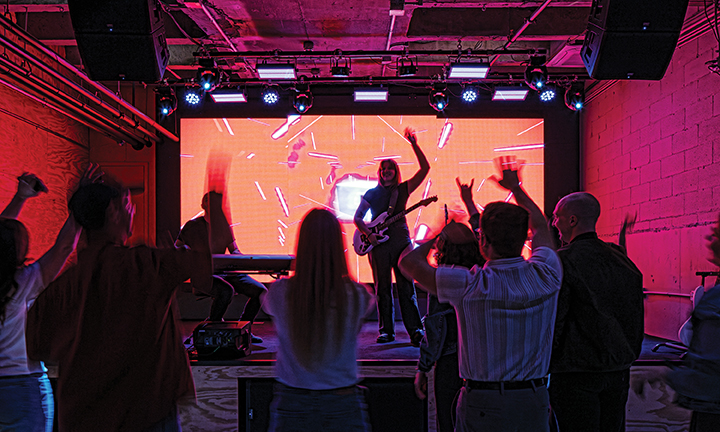
After receiving two sizable American Rescue Plan grants through Nebraska’s Department of Economic Development, it became a priority project for the city, and Ogden pursued making it a reality. The result is the MusicBox, a space equipped for rehearsals, workshops, small music performances and concerts. The new venue transformed a bank drive-thru and former office space just north of 1330 N Street, adjacent to the new job center.
Launched in 2025, owned by the city and operated by the Downtown Lincoln Association, MBX is equipped with a raised stage, professional sound and lighting equipment and a compact recording studio. LED screens provide opportunity for video art, and an outdoor area has space for murals. The MusicBox is available for rehearsal and recording, but also offers a dedicated venue for music education and development.
To further nurture Lincoln’s music scene, Philip Zach, owner of Grid Studio, and his business partner and co-educator Zach Watkins, have designed a three-prong program to “incubate” Lincoln’s young musicians.
Philip Zach has been over the ropes of the music industry. First as a member of an ambitious young band, self-promoting, touring, playing 200+ shows a year, signing with Warner Bros., making the Billboard chart — all lessons in how to interface with the music business. His teaching/business partner, Zach Watkins, an award-winning recording artist, founded two internationally recognized touring bands. Music led him from grade school orchestra to Berklee College of Music then back to Nebraska for music performance degrees. He’s still playing and touring. He founded I SEE MELODY, a collective dedicated to development of music and art, linking young musicians to local industry professionals and offering accessible production services for established artists. As a public-school program educator for over 15 years, Watkins received LPS’s Inspiring Staff Member award in 2022.
Both Zach and Watkins know well that to survive and maybe even prosper, musicians serve as their own promoters, booking agents, managers and producers. The goal of the Music Box is to get the tools of the trade in the hands of young creators so they can discover their strengths and find their place in the music industry, including making music a livelihood.
“Our academy focuses on 5 major pillars of the music business with skill sets in each of those areas. After a working knowledge of all 5 areas, students pick a lane and focus for the entire second half of the semester,” Zach says. The Academy program is there to inspire competence and confidence — through experience with the tools — so musicians can find their passion.
The MusicBox has three options for use. A basic annual membership provides 16 hours a month for rehearsal, recording or performance — in a space that’s affordable and well-equipped.
For detailed, comprehensive training, the MBX Academy offers 8-12 weeks of class (three times a week) during spring and fall semester. The Academy teaches a swath of music industry skills: songwriting, promotion and branding, producing, recording and mixing. Emphasis is placed on technical and business roles within the music business, whether it’s graphic design, sound engineering, promotion or stagecraft.
Last, the MBX Artist Development Program offers selected artists (by application) opportunity for concentrated work with the MBX team to produce and record an EP and music video. Additionally, artists learn to develop branding and promotional strategy from press photos to social media.
Access for all is a fervent goal — to remove barriers to equity, to attract young artists who might not yet know that’s what they are. “I believe in the power of a song to change your life,” says Philip Zach. “MusicBox exists to put the tools of the music industry into the hands of anyone who wants to find their voice. A song can break the cycle of generational poverty, and we are here to give our city’s musicians their best chance to do exactly that.”
Undoubtedly, there will be room for these new voices on the stages of Lincoln’s music district.


Recent Comments