
Life in the Past Lane
How Road Crews Help Unearth Nebraska’s Ancient Giants
by Caroline Clements
Morrill Hall is a destination for those who love fossils — especially mammoths and mastodons. For visitors to Morill Hall, seeing the ancient fossils is a highlight of their trip to Lincoln. What many don’t realize is that most fossils on display were found in Nebraska — ancient elephants, camels, rhinos, horses, and tortoises all diversified in this region. Furthermore, a substantial number of these specimens were found on road construction projects throughout the state.
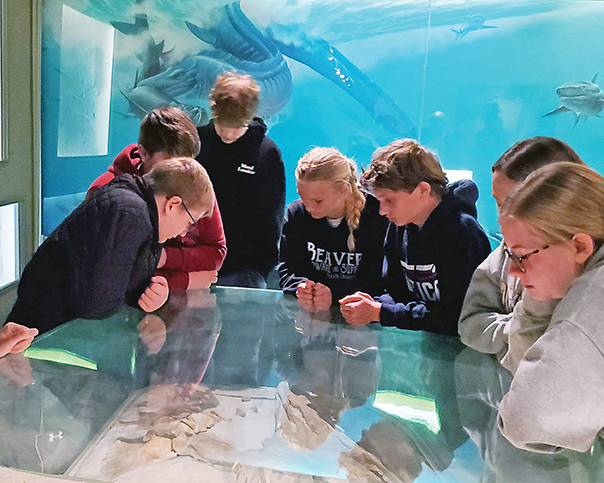
Junior high students join a UNSM educator to examine a mosasaur skull inside Morrill Hall’s Mesozoic Gallery. This specimen was discovered by Jon Morgenson and Steve Brey with Nebraska Game & Parks Commission on a roadcut inside Niobrara State Park and UNSM’s Highway Paleontology team recovered it.
How did road construction projects contribute significantly to the Museum’s fossil collection? In 1960, Nebraska made history by establishing the nation’s first Highway Paleontology Program — a unique partnership between the University of Nebraska State Museum (UNSM) and the Nebraska Department of Transportation (NDOT).
A new exhibit in Morrill Hall, Life in the Past Lane, celebrates the Highway Paleontology Program, the visionaries who founded it, and the collaborations that have made the program successful for over 65 years.
“The Highway Paleontology Program has saved thousands of Nebraska fossils from destruction and made them available for research on Nebraska’s ancient animals, and display for public understanding of our state’s past,” said UNSM director Dr. Susan Weller. “We’re excited to share with the public more of what makes this program special.”
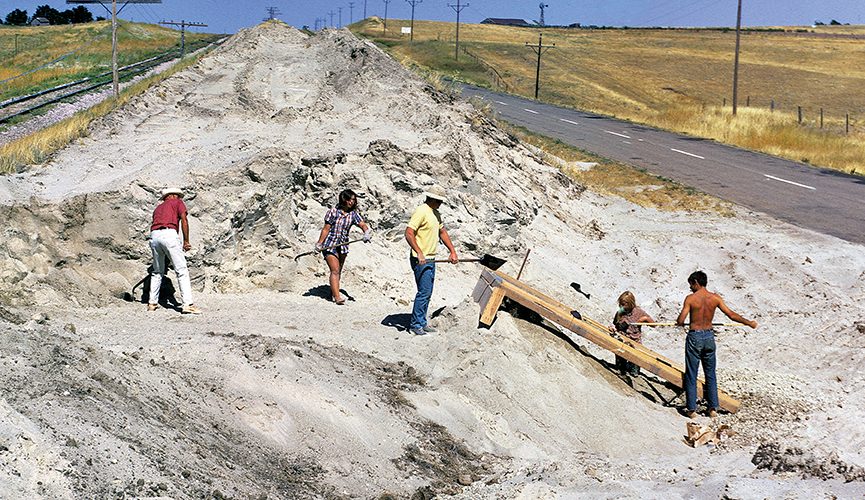
The Highway Paleontology Program relies heavily on teamwork between NDOT road crews and UNSM paleontologists. Museum paleontologists will review plans and examine roadcuts before construction begins to pinpoint areas with the greatest potential for containing fossils. However, many fossil discoveries on construction projects also happen by chance as sediment is disturbed by heavy machinery. In those instances, NDOT crews reach out to UNSM, and paleontologists work with the crews on plans to recover the fossils before construction damages or destroys them.
The collection of fossils involves more than simply removing them from the ground and transporting them to the museum. Fossil sites at a distance can seem like crime scenes. Researchers collect and record as much data as possible before removing the specimen. That data, or “field notes,” is often used by researchers decades after the fossil has been collected.
Gravel pits where sand and gravel are mined for NDOT projects often yield fossils as well. These areas contain deeply buried specimens that are brought to the surface during the mining process. The Highway Paleontology Program collects these fossils and adds them to the museum collection. Many of the fossils found in these pits are also provided to UNSM through the Highway Paleontology Program.
For both NDOT and UNSM, weather conditions, regulatory issues, surface vegetation, and wildlife can all create challenges to construction and fossil recovery. However, since the program’s creation, fossil recovery has never delayed a road construction project.
Instead, the program has enhanced the scientific understanding of Nebraska’s geology, as well as the plants and animals that once called Nebraska home. To date, more than 200,000 fossils have been recovered by the Highway Paleontology Program from 76 of Nebraska’s 93 counties. These fossils include 35 new species. In addition, tens of thousands of Nebraskans have been introduced to geology and paleontology through visits to Morrill Hall as well as classroom presentations and community visits by UNSM paleontologists and educators.
“Fossils are one of the historical treasures of the science world,” said Dr. Weller. “I hope visitors to Morrill Hall will explore this new exhibit and better appreciate the workers with NDOT and paleontologists who came before us who ensured the Highway Paleontology Program could preserve these treasures for future generations of Nebraskans.”
Life in the Past Lane, along with four floors of additional fossil, natural history, and world culture exhibits, is open to the public at Morrill Hall. All museum exhibits are included with admission. A complete list of museum exhibits is available on the museum website, museum.unl.edu.


Recent Comments