Nebraska’s Amazing Unicameral
by Julie Nichols • photo by Tom Tidball
“Every act of the legislature and every act of each individual must be transacted in the spotlight of publicity.”—George Norris
Among Nebraska’s distinctions is its unicameral legislature, the sole state to elect a single governing body, and the only state to employ both filibuster and the cloture rule in the manner of the U.S. Senate. Three states began as one house, but shifted to bicamerals by the early 1830s. Nebraska began as bicameral and chose the unicameral less than a century ago.
Senator George W. Norris, viewed as the father of the Unicameral, contended all states should adopt the one-house legislature. A New Deal Republican, Norris became impassioned about streamlining Nebraska’s government, arguing that not only was the bicameral system outdated, it modeled Britain’s parliament — half were social elites appointed by the king. Although there was no king, Norris felt government needed to serve constituents, not special interests. He insisted that in a unicameral, committees could not readily hide their actions and greater transparency would result if committee votes were public, providing a means for citizens to respond.
A central argument for the unicameral was purely economic: reducing the number of lawmakers reduced cost. Concerns about preserving checks and balances in a single house, Norris insisted, would be addressed by supreme court or governor ruling on improper actions. Furthermore, the body should be nonpartisan, leaving party quarrels — at least theoretically — outside the chamber. Committees reviewing and issuing bills would be open to public hearings where stakeholders’ testimony could register support or disapproval.
The unicameral amendment passed overwhelmingly by popular vote. The 133-seat bicameral shrank to 43 legislators. The first unicameral election, in 1936, seated senators from three districts determined by geographic lines. This smaller governing body reduced salary costs by nearly 70 percent.
Immediately, the efficiency of the new system revealed its advantages: the number of committees was slashed from 61 to 18. The number of bills introduced was half the previous session — still nearly 600. The final bicameral session went 110 days and passed 192 bills. Two years later, the first unicameral session passed 214 bills in 98 days. The cost to the taxpayer fell by 50 percent.
The Second House
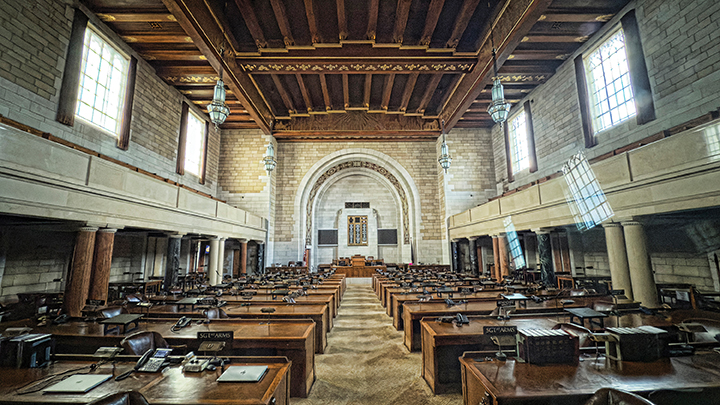
Crucial, though, were the two defining measures of the new unicameral system: a strictly nonpartisan body and the means for citizen engagement. Nebraska citizens comprise “the second house” with rights to petition against unfavorable laws by direct appeal. The press is afforded greater access to the legislative process, raising awareness, and providing constituents a substantial role to support or dispute proposed bills in open public hearings. All testimony, both written and oral, goes into the public record. Galleries in the legislative chamber allow press, constituents (and school groups) to watch debate. Citizens can even send messages to their senator, pulling them from the floor, to share immediate concerns. Thus, Nebraskans embody the “second house,” their directive given credence by the inscription on the entrance to Nebraska’s capitol: The Salvation of the State is Watchfulness in the Citizen.
The unicameral’s directive to nonpartisanship has always been jostled by partisan issues among the body. But at the very least, it eliminates party language, and often senators unite across party lines to collaborate on desired legislation. Certainly, in recent years, introduction of hotly contested bills has ushered in enhanced partisanship, but also increased involvement of the Second House. Committee rooms fill to overflowing; press conferences and protests take place outside the chamber. While some view this as disruption, others feel pride that Nebraskans are getting involved in lawmaking.
How does a bill become law?
Essentially, all legislation gets three readings and two chances for debate. Once past public testimony, it moves to General File, considered the most fluid portion of the process and most likely to see modification and collaboration. If passed, it moves to Select File for further debate, and if passed, moves to Final Reading. However, intervening filibusters, as well as proposed amendments, can slow and lengthen the days of debate.
Cloture and the Filibuster
Already unique, the Nebraska Legislature is the only one to employ both the filibuster and cloture rules.
The Filibuster
Sometimes referred to as “talking a bill to death,” the filibuster is as old as the Roman Senate, and allows any member of the body to speak in unlimited fashion. While time limits have been placed on filibuster in our times, it can still be applied powerfully, though only14 state legislatures allow it. It’s viewed more as historical oddity than useful methodology except in Nebraska, where a filibuster — or the threat of one — is more a feature than a bug.
As evidenced by its historic use in 1957 to stultify the passage of civil rights legislation, filibuster is seen as a tool of obstruction. U.S. Senator Mitch McConnell earned the moniker “grim reaper” for using it to bludgeon democratic initiatives. The filibuster functions best in the unicameral to slow legislation, to increase fruitful discussion and compromise. In the best-case scenario, it makes better laws and prohibits unjust ones.
Cloture
Cloture rules intend to end or limit debate, and Nebraska is one of only ten states that use it. Introducing multiple amendments and motions are common tools to forestall a final vote. Determined to find a way to conclude extended debate, legislators considered the adoption of a cloture rule. After two proposals failed, in 1981 a cloture rule was established.
The current rule allows few the power to invoke cloture: the primary introducer, a co-introducer with consent, or a committee chairperson. Once invoked, cloture is not debatable and takes priority except for motions to recess or adjourn. The presiding officer can rule the motion out of order if he or she believes there has not been full and fair debate. This ruling cannot be challenged. Since 2002, the Speaker of the Legislature has established timeframes for full and fair debate, as well as implemented other informal practices to control the agenda and manage the legislative workload.
A successful cloture motion requires two-thirds majority. If successful, subsequent votes are taken on all matters attached to the underlying bill. If the original amendment has been divided, a vote is taken on the original undivided amendment. The final vote is on a motion to advance the underlying bill.
If a cloture vote fails, debate ends for the day. When the bill comes back up for consideration, two additional hours of debate must occur before cloture can be invoked.
Women in the legislature
With a 30 percent increase nationwide in women elected to state legislatures since 2018, the current unicameral’s 18 female senators, evenly split between parties, represent 37 percent of Nebraska’s unicameral.
Former Senator Julie Slama, known for her conservatism, argued alongside Senator Cavanaugh and other left-leaning members to block the governor’s raise of sales and excise tax, because it would hurt working families. “It is just so critical to have women in these debates because it represents a different perspective in Nebraska that hasn’t always been represented,” Slama said.
Senator Danielle Conrad, who is now serving a third term, comes into session with prepared bills, as do other women. “Budget and tax might sound dry, but it’s absolutely bread and butter issues. It’s absolutely kitchen-table economics,” Conrad said.
Nebraska ranks 19th among states for the number of women lawmakers. However, Republican efforts to eliminate diversity and inclusion may obstruct even conservative women in conservative states. States whose rules require gender balance in state government, such as Iowa, are repealing those requirements.
The lion of the legislature: Ernie Chambers
No mention of Nebraska’s politics could omit Ernie Chambers, senator from Omaha’s 11th District, the first black man elected to the unicameral; his 46-year tenure makes him Nebraska’s longest-serving state senator. A champion of civil rights, an LGBTQ and women’s ally, and an environmentalist, Chambers argued for a law against marital assault; Nebraska’s was the first in the nation. He is a lifelong opponent of the death penalty; his 2015 bill abolishing the death penalty passed the legislature and a governor’s veto, only to see a successful ballot initiative (massively funded) which reinstated the death penalty by popular vote. He supported environmental protection and opposed projects like the KXL pipeline. Ernie considered himself the “champion of the downtrodden” and never wavered from that goal. With a law degree from Creighton, his oratory was erudite, skilled, biting, anomalous, and dramatic; he often caught and called out errors in procedure or definition. He was well-known for reading his own poems during filibuster, and for his acerbic “Erniegrams”, short verses sent to his opponents. His “uniform” was a sleeveless purple sweatshirt and jeans. He retired in 2021.



Recent Comments