
The “Lincoln Monument”
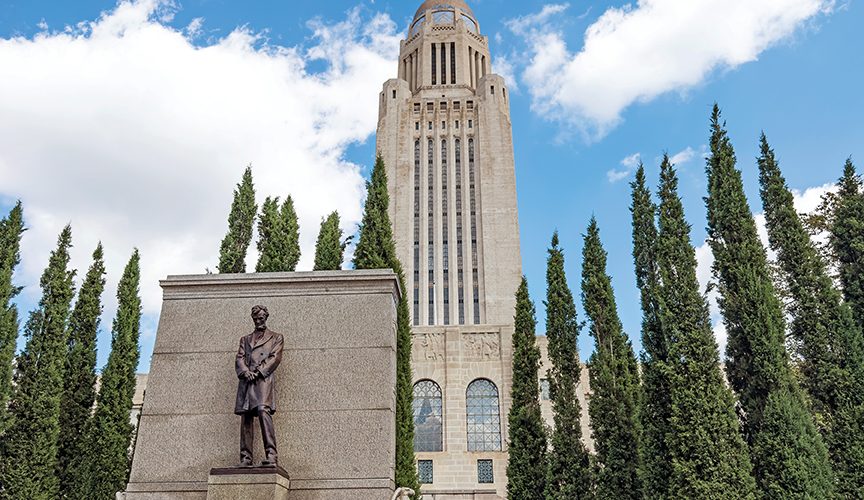
… in bronze & granite at the Nebraska State Capitol
by Ed Zimmer • photos by Tom Tidball
Lincoln Memorial in Washington, D.C. is one of America’s foremost landmarks, honoring the man many historians regard as America’s greatest president. Henry Bacon was the architect of that beautiful Lincoln Memorial, which shelters the monumental, seated figure of Abraham Lincoln, sculpted in marble by Daniel Chester French. The landmark on the Potomac was constructed from 1913 to 1922.
In Lincoln, Nebraska, the largest city named for Abraham Lincoln, there is another monument created jointly by sculptor French and architect Bacon in commemoration of President Lincoln. This memorial has graced Nebraska’s capital city since 1912, a year before construction began on Lincoln Memorial in the national capital and a decade before the Washington, D.C. landmark was dedicated.
On the center of the west side of Nebraska’s Capitol Square is a monumental bronze statue of Lincoln facing west towards Lincoln Mall across South 14th Street. Atop a 5-foot granite pedestal, the statue is about 8.5 feet tall and is backed by a taller granite tablet inscribed with the full text of the “Gettysburg Address.” Let’s look at when, why, what, how and who brought this Lincoln Monument to Lincoln, Nebraska.
There were several unsuccessful efforts to establish an Abraham Lincoln monument in Nebraska’s capital city prior to 1912. A local stone carver, John Curry, established a gravestone business in Lincoln in the early 1870s. In the 1890s he began modeling a life-sized statue of Lincoln. Curry undertook fund-raising among Civil War veterans in hopes of sculpting a permanent bronze or marble statue from his model. A Lincoln newspaper opined in 1896 that Curry’s “exact technical and artistic status… may not be thoroughly established, but one thing is clear, he is a hustler.” Curry persuaded the State of Tennessee to donate two large blocks of gray marble for his project. He presented the bill to Nebraska’s governor for shipping the stones to Lincoln and stored the stones on the Capitol grounds.
The Tennessee marble was still languishing on those grounds in 1908, when Lincoln’s “Young Men’s Republicans Club” proposed a bold framework for creating a monument. Mindful that the centennial of Abraham Lincoln’s birth was just one year away, the Club suggested that Nebraska’s elected leaders should form a memorial association, charging themselves with securing state funds as well as private donations. Nebraska’s Governor Sheldon agreed to lead the “Abraham Lincoln Centennial Memorial Association of Nebraska,” with participation from other state officers including the Secretary of State, Treasurer, and Attorney General. Confident of raising the necessary funds, the Association members invited F. M. Hall, a leading Lincoln attorney and respected art enthusiast, to recruit a committee to guide the process of selecting an artist and approving a design for a monument on the Capitol grounds.
Lincoln newspapers mentioned several potential artists including John Curry, Rudulph Evans (who had sculpted the J. Sterling Morton monument unveiled in 1905 in Nebraska City), and Hermon Atkins MacNeil (whose William McKinley monument at the Ohio Statehouse had recently been finished). While residing in Omaha, Swiss-born sculptor Xavier Stadler in 1908 wrote to the Memorial Association to offer his services, stating that around 1900 he had sought permission to carve a figure of Lincoln out of one of the Tennessee marble blocks. The sculptors Gutzon and Solon Borglum were favored by some of F. M. Hall’s committee members for their Nebraska connections. But the brothers both withdrew from consideration rather than compete against one another. (Gutzon’s fame as the lead sculptor of Mt. Rushmore was still years in the future.)
None of those artists received the committee’s nod. Instead, F. M. Hall was tasked with traveling to New York City in mid-1908 to offer the commission to Daniel Chester French, on two conditions. The cost for the monumental bronze was capped at $20,000 and French was to prepare a model for the committee’s viewing and approval in Lincoln. Fifty-nine-year-old French accepted the commission with zeal. Nebraska newspapers endorsed French’s selection. Among them was Lincoln’s The Independent Farmer and Swine Breeder, which cited several of French’s successful major commissions. The writer noted that French “now is looked upon as the foremost American sculptor,” adding “The committee has done well in putting aside all temptations to experiment and in seeking at once a master for this work.”
It was well understood that an architectural setting would be needed for the bronze statue and that French would “associate with him some eminent men in designing the architectural accessories.” When French came to Lincoln in November of 1909 to view the Capitol grounds and advise on placement of the statue, it was no surprise that New York City architect Henry Bacon accompanied him. They had previously collaborated on several sculptural projects and Bacon had recently designed “Chesterwood,” French’s 1901 summer house and studio in Stockbridge, Massachusetts.
The designers were accompanied by F. M. Hall, Governor Shallenberger, newspaper reporters, and others on that initial site visit. Each side of the grounds of the “Second” Nebraska State Capitol (built in the 1880s) was considered, with the advantages and disadvantages of each debated. Like the current building, that Capitol faced north, but it also had carriage drives accessing both the east and the west sides. On the south side of the grounds was the Capitol’s heating plant with a substantial smokestack, which quickly eliminated that location. To the east, J Street extended only one under-developed block on-center with the Capitol, and so the east side was ruled out. French balked at orienting a sculptural figure northward, to avoid shadowing its face most of the day.
Architect Bacon countered with a suggestion to widen K Street north of the Capitol to accommodate a central, circular landscaped space for the statue, facing south towards the Capitol. A Lincoln newspaper even published a sketch of Bacon’s idea, showing 15th Street extended and enhanced all the way to a larger University campus at R Street, foreshadowing the development of Centennial Mall by six decades. But the state appropriation in support of the monument project specified the Capitol grounds, not a nearby street, so Bacon’s big idea was vetoed. The Governor even suggested a placement on one corner of the Capitol grounds, envisioning a future pairing of Lincoln’s monument with a Stephen Douglas statue on another corner. French strongly recommended placing the monument on the west side. Perhaps as much for its lack of disadvantages as for the superiority of a westward vista, the committee acceded.
Work on the clay model for the statue was well underway in mid-1910, when French advised Hall’s committee that his design concept needed further study, so he would not submit it for approval until after a planned fall trip to Europe. In December French informed Hall he had started a new model upon his return which was “now well on the road to completion,” which he expected by January of 1911.
Lincoln newspapers reported at the end of January that French and two plaster models had arrived in Lincoln. The committee quickly met and “heartily” endorsed one of them. That plaster model, which French presented to F. M. Hall, was temporarily displayed at the University Library (now Architecture Hall), then was relocated for a time to the City Library at South 14th and N streets, “placed on a pedestal on the south side of the rotunda.” Hall’s plaster figure was eventually bequeathed by F. M. and Anna Hall to the Nebraska Art Association (NAA) and is now treasured by NAA’s successor, the Sheldon Museum of Art.
French returned to his New York City studio to complete the full-sized figure, working from both his small clay model and a second plaster casting, towards a 1912 completion. A Brooklyn newspaper described a reception in January of 1912 at French’s Manhattan studio featuring the full-sized clay model. A careful observer described: “The attitude of the war president is that of profound meditation. The head is bowed, the hair lightly and carelessly tossed about, one lock hanging on the forehead, increasing the neglect of personal appearance characteristic of Lincoln in moments of abstraction.”
In 1912, Lincoln newspapers announced as “a matter of interest and a certain pride” that Henry Bacon had been selected in a hotly contested competition as architect for the Lincoln Memorial in Washington, D. C. Bacon visited Lincoln again on a cross-country trip early in 1912 to review progress on “the architectural accessories” for Lincoln, Nebraska’s monument. He could also report on good progress on the granite work in Chicago and on the bronze casting at the “Jno. Walters Foundry” in New York.
By mid-May of 1912, a Lincoln newspaper reported and illustrated that the granite setting for the Lincoln monument was nearing completion. The masonry was the work of the Kimball Bros. monument company of Lincoln, at a cost of $7,000. Overall, the statue and its setting were closely comparable in cost, at $20,000 each — a combined expenditure equivalent to approximately $1.3 million in 2025 dollars.
All was ready for a grand unveiling on September 2, 1912. A platform was constructed at the north entrance of the Capitol where the state band played “patriotic airs” and a “large and well-trained chorus” joined the band in “Hallelujah.” William Jennings Bryan delivered the main address on Lincoln and his character, before the ceremony shifted to the west side for the actual unveiling. A crowd estimated at 50,000 watched two Civil War veterans draw back the flags which had veiled the sculpture. In closing, F. M. Hall spoke on “A Work of Art and the Sculptor,” describing Daniel Chester French as pre-eminent in his field in the nation. At a reception luncheon following, “when the sculptor was called upon for a few words his gratification was shown in an emotion that left him without many words,” except to share equal credit with his friend Henry Bacon.
A scant decade after Nebraska’s granite and bronze “Lincoln Monument” was dedicated, the state adopted Bertram Grosvenor Goodhue’s striking tower design for a new Nebraska State Capitol. Besides the site itself, the only feature of the earlier capitols retained when the new building was completed in 1932 was Daniel Chester French’s and Henry Bacon’s original, 1912 homage to Abraham Lincoln, holding the foreground of the 400-foot tower with strength and dignity.


Recent Comments